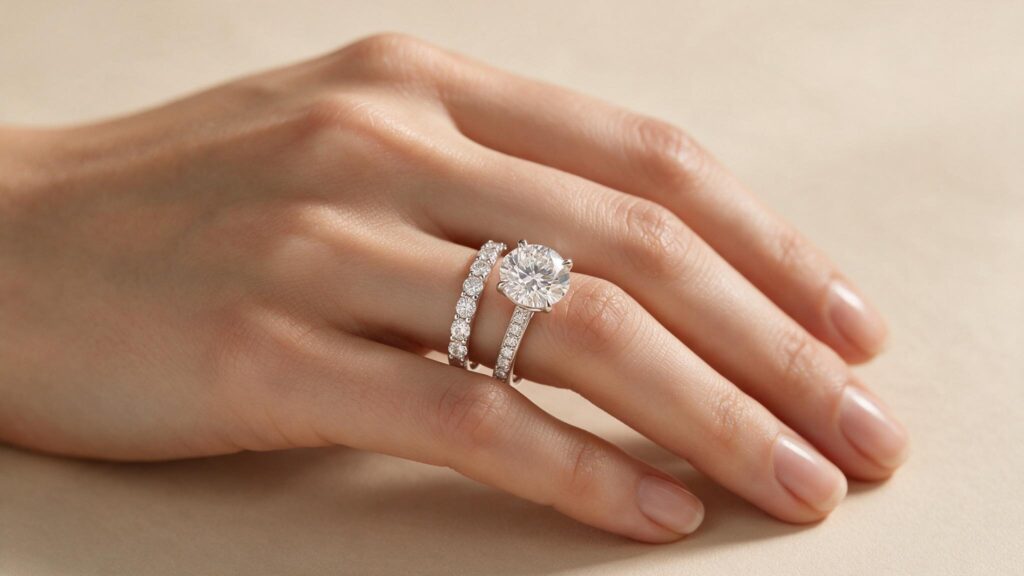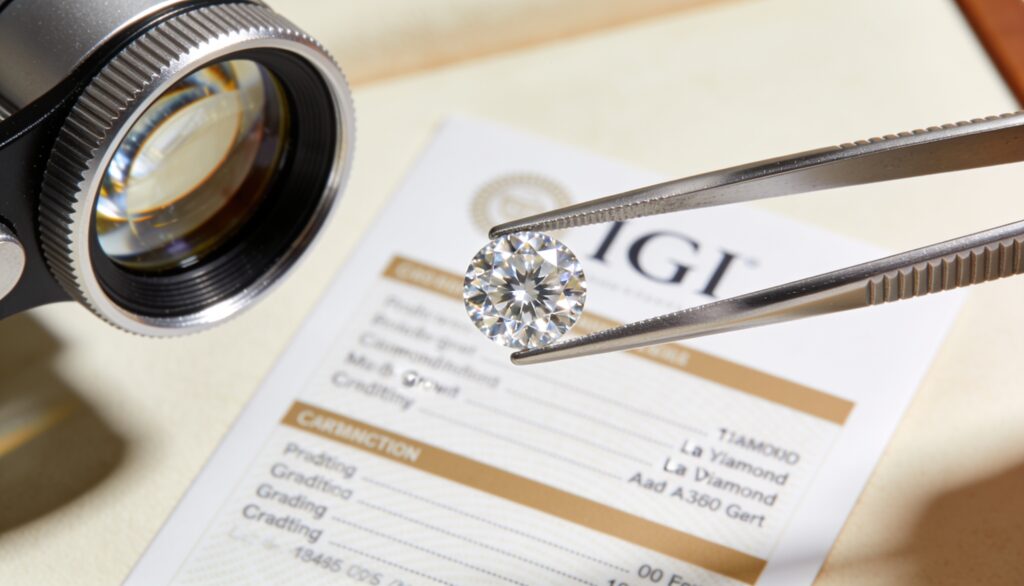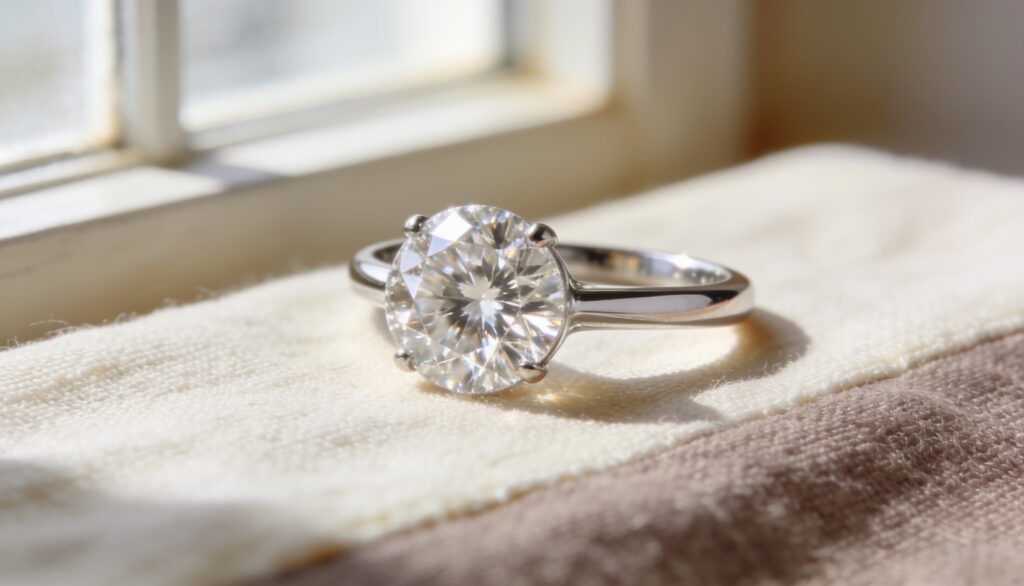
Here’s what nobody tells you about the lab grown vs natural diamonds debate: the difference that actually matters for most buyers is not what most comparison articles focus on. The two stones are chemically identical. Optically identical. Same hardness. Same sparkle. Same certification. What’s actually different is pricing (lab saves 70 to 80 percent), resale value (natural holds better), and environmental impact (108-160 kg CO2 for mined, 15-50 kg for lab). Those three differences are the whole real conversation.
I’m Suman Smith, founder of Lux Jewels. I introduced lab grown diamonds to Canada in 2015 as the first jeweler to do so. I also still sell natural diamonds. I don’t push one over the other. What I do is tell buyers the honest trade-offs so they can make the right call for their budget and values. Most online comparisons are written by retailers with a financial interest in one side winning. This one isn’t.
Quick Answer
Lab Grown vs Natural Diamonds
Lab grown and natural diamonds are chemically identical (both 100% carbon), optically identical (same brilliance and sparkle), and physically identical (both 10 on Mohs hardness). The FTC confirmed in 2018 that lab grown stones meet the full legal definition of a diamond. Real differences: lab grown costs 70 to 80 percent less (BriteCo 2025), natural holds resale value better (25-50 percent vs 5-20 percent), and mining produces 108-160 kg CO2 per carat vs 15-50 kg for lab grown with renewable energy.
Last updated: April 2026 | Written by Suman Smith, first jeweler to introduce lab grown diamonds to Canada (2015)
Are Lab Grown Diamonds Real Diamonds?
Yes. Not “real enough.” Not “basically real.” Real. Lab grown diamonds share the exact same chemical composition as natural diamonds (pure crystalline carbon), the same optical properties (refractive index, brilliance, fire), and the same physical properties (10 on the Mohs hardness scale). The FTC confirmed this officially in 2018 when it removed the word “natural” from the legal definition of a diamond. A gemologist cannot tell them apart with standard equipment.
I covered the real-diamond question in depth in the Page 1 buyer guide. Short answer here, full explanation there:
Lab Grown vs Natural Diamonds: The Visual Comparison
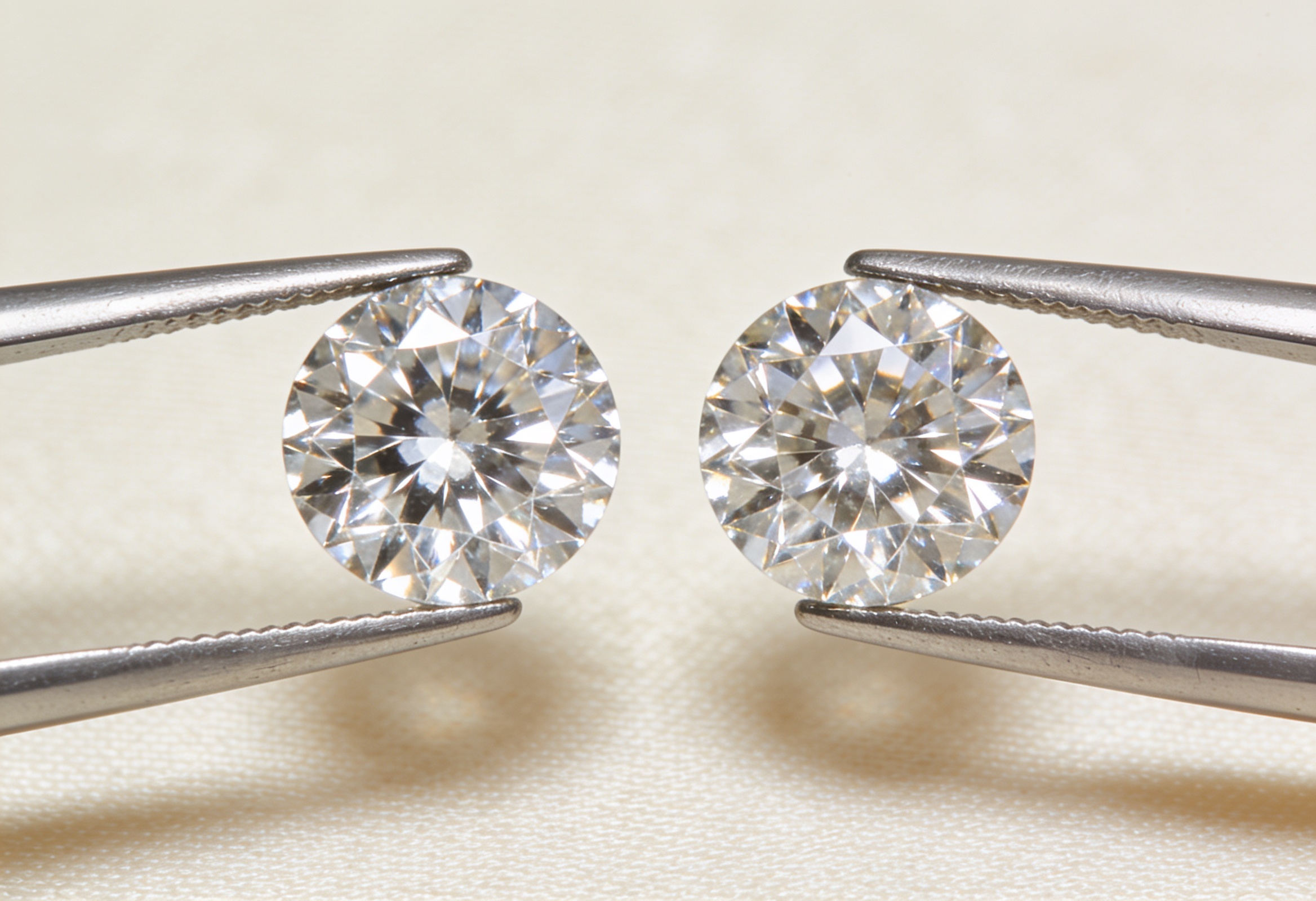
Put a 1-carat lab grown diamond next to a 1-carat natural diamond at the same color grade, clarity grade, and cut grade. Spin them under the same light. Photograph them at the same angle. You cannot tell which is which. Neither can your jeweler. Neither can an independent gemologist with standard tools. Distinguishing them requires specialized laboratory equipment like DiamondView, which measures UV fluorescence patterns that reveal growth history. That equipment lives in gem labs, not in jewelry stores.
Prices are based on current market. Rates vary based on supply and demand and other variables.
Chemical Identity
Both are pure crystalline carbon. Same atomic structure (face-centered cubic lattice). Same bond angles. Same carbon isotope ratios in most cases. A diamond is defined by its structure, not its origin. Lab grown diamonds meet that structural definition completely.
Optical Identity
Refractive index: both 2.417. Dispersion (fire): both 0.044. Hardness: both 10 Mohs. Critical angle for total internal reflection: identical. Result: brilliance, fire, and sparkle look the same to the naked eye because the underlying physics is the same.
Physical Identity
Same hardness (scratches nothing except another diamond). Same density (3.52 grams per cubic centimeter). Same thermal conductivity (which is why diamond testers read both as diamond). Same cleavage planes. Wears the same over 50 years of daily use.
The Only Real Differences
Factor | Lab Grown | Natural (Mined) |
Origin | Lab chamber, 2-4 weeks (CVD method) | Earth mantle, 1-3 billion years |
Price | 70-80% less for same specs | 70-80% more for same specs |
Resale value retention | 5-20% | 25-50% |
CO2 per carat | 15-50 kg (with renewable energy) | 108-160 kg |
Water per carat | 18-600 liters (grower dependent) | 480 liters average |
Earth displaced per carat | None | Up to 250 tons |
Supply chain layers | 1-2 (grower, cutter, retailer) | 4-5 (miner, trader, cutter, wholesaler, retailer) |
Certification labs | GIA, IGI | GIA, IGI |
Everything else is marketing. Including the word “natural” when it’s used as a quality claim.
Lab Diamond vs Real Diamond: Why "Real" Is Misleading
Every week someone searches “lab diamond vs real diamond.” The framing is the scam. Lab diamonds are real diamonds. The question people actually mean is “lab diamond vs mined diamond” or “lab diamond vs earth-formed diamond.” The word “real” got attached to mined diamonds through decades of De Beers advertising, not through anything scientific.
Here’s the test. A cubic zirconia is not a real diamond. It has a different chemical composition (zirconium dioxide, not carbon), a different hardness (8.5 Mohs, not 10), and a different refractive index (2.16 vs 2.42). A diamond tester reads it as “not diamond.” A gemologist identifies it instantly. That’s a fake.
A moissanite is not a real diamond. Different composition (silicon carbide), different hardness (9.25), different light dispersion (0.104 vs 0.044 for diamond). Diamond testers read moissanite as “diamond” because thermal conductivity is similar, but specialized testers catch it. Also not a real diamond.
A lab grown diamond passes every real-diamond test. Diamond tester reads it as diamond. Gemologist confirms it as diamond. Certificate grades it on the same 4Cs scale. The only way to identify it as lab grown is specialized laboratory equipment looking at growth patterns. That’s because it is a diamond. Just one that wasn’t mined.
What the FTC Ruled in 2018
In 2018 the US Federal Trade Commission updated its Jewelry Guides. Before 2018, a “diamond” was legally defined as “a natural mineral made almost entirely of pure carbon crystallized in the isometric system.” After 2018, the word “natural” was removed. The legal definition now reads: “a mineral made almost entirely of pure carbon crystallized in the isometric system.” Lab grown diamonds meet that definition. Full stop.
The FTC also required clearer disclosure. A lab grown stone has to be labeled “laboratory grown,” “laboratory created,” or “synthetic” so buyers know what they’re getting. It cannot be sold as a mined diamond. But it also cannot be called “not a real diamond.” That phrasing is factually wrong and legally misleading.
Lab Grown vs Natural Diamond Prices
This is where the debate gets practical. Same stone, same specs, same visual quality. Different price by a factor of 3 to 5. Here’s what that actually looks like in 2026 CAD:
Carat Size | Lab Grown (D-F, VS1+, Ex cut) | Natural (D-F, VS1+, Ex cut) | You Save |
0.5 ct | $475 - $900 | $2,200 - $4,500 | ~78% |
1.0 ct | $950 - $2,000 | $5,700 - $11,500 | ~82% |
1.5 ct | $1,600 - $3,200 | $11,000 - $20,000 | ~83% |
2.0 ct | $2,400 - $6,000 | $20,000 - $33,000 | ~81% |
3.0 ct | $5,500 - $11,000 | $40,000 - $65,000 | ~83% |
Why the Gap Exists
Supply chain. Natural diamonds pass through 4 to 5 layers of middlemen (miner to rough trader to cutter to wholesaler to retailer). Each layer adds 15 to 30 percent markup. Lab grown stones pass through 1 to 2 layers (grower to cutter to retailer). Compressed supply chain, compressed price. That’s the entire explanation. Not “one is better quality” or “one is more rare.” The rarity is manufactured by De Beers stockpiling, not by actual scarcity.
For the full 5-layer supply chain breakdown, see the Page 1 pricing section:
Not sure which direction makes sense for your budget?
On a free jewelry consultation we run the numbers for your specific situation. Lab or natural, we tell you what fits.
Free | 30 to 40 minutes | Video call
Why Are Lab Grown Diamonds More Affordable?
Three reasons, ranked by how much they matter.
One: fewer middlemen. Already covered. Natural has 4-5 markup layers, lab has 1-2.
Two: production cost per carat. A 1-carat lab grown diamond costs the grower roughly $200 to $400 CAD to produce. A 1-carat mined rough costs $500 to $1,500 CAD to extract after accounting for exploration, mining overhead, sorting waste, and transport. Both get multiplied through cutting, polishing, certification, and retail, but they start at different base costs.
Three: no manufactured scarcity premium. Natural diamond pricing is held artificially high by coordinated supply control. De Beers and other major producers stockpile to restrict flow into the market. Lab grown production doesn’t work that way. Growers compete on actual cost-to-produce, not on maintaining a cartel floor price. This is why lab grown prices have dropped 40 percent since 2020 while natural prices stayed flat.
Do Lab Grown Diamonds Hold Their Value?
Not as well as natural. Neither is a good investment. Here’s the real picture.
Resale Value Reality
Diamond Type | Resale % of Retail | Why |
Natural (mined) | 25-50% | Scarcity narrative + secondary market exists |
Lab grown | 5-20% | Supply is expanding; new stones more affordable each year |
Either type (bought from retail) | Lose 40-60% immediately | Retail markup evaporates at resale |
Neither Is a Good Investment
Read those numbers again. A $10,000 natural diamond ring sells for $2,500 to $5,000 on the secondary market. A $10,000 lab grown diamond ring sells for $500 to $2,000. Both lose most of their retail value immediately. This is true of almost all retail jewelry. If you’re buying for investment returns, you’re shopping the wrong category entirely.
Buy an engagement ring because you want something the person wearing it will love for 40 years, not because you think the stone will appreciate. The ring’s value is in the marriage, not in resale. The natural-diamond resale argument is real but overstated. The lab grown resale disadvantage is real but irrelevant for most buyers who plan to keep the ring forever.
The Honest Disadvantages of Lab Grown Diamonds
Most lab grown advocacy articles skip this section. I’m not skipping it. Here’s what’s actually on the minus side, told straight.
1. Resale Value Is Genuinely Lower
Covered above. If you care about selling your ring 10 years from now, natural holds a bigger percentage. This matters for some buyers. It doesn’t matter for most buyers who plan to keep the ring forever, but it’s not zero.
2. Prices Keep Dropping
The 2-carat lab grown ring you buy today for $4,000 CAD will cost $2,800 CAD in three years at current price trajectories. For buyers, this is good. For the “rare and precious” emotional framing, it’s a problem. Some people specifically want the stone on their hand to feel geologically rare. Lab grown isn’t that. It’s abundant and getting more abundant. That’s a feature if you value access. It’s a drawback if you value scarcity.
3. The Formation Story Is Different
A natural diamond formed 1 to 3 billion years ago, 150 kilometers underground, under geological conditions Earth no longer produces. A lab grown diamond formed last month in a vacuum chamber. Same atoms. Same structure. Different origin story. Some people care deeply about this. For them, lab grown feels wrong regardless of science. That’s a legitimate preference, not a misinformed one.
4. Energy Source Varies
Environmental benefit of lab grown depends on where the electricity comes from. A CVD grower running on coal-heavy grid power creates 30-50 kg CO2 per carat. A CVD grower running on solar or hydro creates 15-20 kg CO2 per carat. Both beat mining (108-160 kg CO2), but the gap varies. Good growers publish their energy sourcing. Some don’t. If environmental impact is your main driver, ask the grower directly or buy from retailers who have verified renewable-powered supply chains.
5. Some Growers Have Labor Issues
The vast majority of CVD and HPHT diamond production happens in India and China. Most facilities meet international labor standards. Some don’t. “Lab grown is automatically ethical” is a marketing claim, not a guaranteed fact. Responsible retailers verify grower labor practices. Ask who grew your stone and where. If the answer is vague, that’s information.
The Environmental Impact: Real Numbers
Here’s the environmental comparison with actual numbers, not marketing claims. All figures come from peer-reviewed Life Cycle Assessment studies published between 2019 and 2024, which is why I cite ranges rather than single numbers (different studies use different system boundaries).
Mining Environmental Data (per carat)
- CO2 emissions: 108 to 160 kg per carat (peer-reviewed LCA range)
- Water consumption: 480 liters per carat average
- Earth displaced: up to 250 tons per carat (depending on mine type)
- Air pollution: approximately 2,011 oz per carat
- Land disturbance: permanent for open-pit mines
Lab Grown Environmental Data (per carat)
- CO2 emissions: 15 to 50 kg per carat (depends on electricity source)
- Water consumption: 18 to 600 liters per carat (grower-dependent)
- Earth displaced: none
- Land disturbance: factory footprint only (tiny vs mining)
- Energy-intensive: yes, but scales with clean grid
What 1 Carat Lab Grown Saves (Best Case)
If you buy a 1-carat lab grown diamond grown with renewable energy instead of a mined equivalent, you save roughly 143 lbs of carbon dioxide, 120 gallons of water, 250 tons of earth displacement, and 2,011 oz of air pollution. That’s the number I cite on Instagram and client calls. Those are best-case savings assuming renewable-powered lab vs typical mining. Worst-case (coal-powered lab vs efficient mining) the CO2 savings shrink to maybe 80 lbs, but the earth-displacement gap stays massive because lab grown moves zero earth.
The Honest Caveats
Environmental lab-vs-natural comparisons depend heavily on assumptions. A lab powered by renewables easily beats mining on every metric. A lab powered by coal-heavy grid electricity has a smaller CO2 advantage. The earth-displacement comparison is always decisive in favor of lab grown because mining physically removes hundreds of tons of rock per carat extracted. The water comparison varies by mining region (some mines use recycled water extensively) and by grower (some CVD chambers use minimal water, others use more for cooling).
Are Lab Grown Diamonds More Ethical?
Usually yes, but with asterisks. Here’s the actual ethics comparison.
Where Mining Has Real Human Rights Issues
Some diamond-producing regions have documented records of forced labor, child labor, and funding armed conflict (the “blood diamond” issue). The Kimberley Process (industry self-regulation) addresses some conflict sourcing but has significant gaps. Not all mined diamonds carry these issues. Canadian diamonds, Australian diamonds, and diamonds from Botswana mostly don’t. African artisanal mining sometimes does. The problem is most retail buyers can’t trace their specific stone’s mining history back to the specific mine, so “this diamond is conflict-free” is often a probabilistic claim rather than a verified one.
Where Lab Grown Doesn't Automatically Win
Lab grown has no mining human rights issues. That’s real. But cutting and polishing happens in the same factories that cut mined diamonds (India and China dominate this step). Labor conditions in cutting facilities vary. Energy sourcing at growing facilities varies. Lab grown isn’t automatically ethical. It’s ethical-by-default at the mining stage and needs verification at the cutting and growing stages.
The Honest Answer
If ethics is your top concern, lab grown diamonds from renewable-powered growers with verified labor practices are the cleanest option available in 2026. Lab grown diamonds from unverified growers are still usually cleaner than mined, but with less certainty. Mined diamonds from Canadian, Australian, or Botswanan sources with traceable certification are also ethical options. Mined diamonds from untraceable sources carry the most ethical risk. The answer depends on sourcing verification more than on lab-vs-mined framing.
The FTC 2018 Ruling: What It Actually Says
If you want to understand why the “real diamond” framing is legally wrong, you need the FTC ruling. Here’s what actually happened in 2018.
What Changed
The US Federal Trade Commission revised its Jewelry Guides in July 2018. Before this, the legal definition of a diamond included the word “natural.” This meant retailers could argue that lab grown stones weren’t technically diamonds, which allowed them to frame lab grown as “fake” or “not real.” After July 2018, the word “natural” was removed. The definition now reads: “A diamond is a mineral made almost entirely of pure carbon crystallized in the isometric system.” Both lab grown and mined stones meet that definition.
What It Required
The ruling also required clearer disclosure. Lab grown diamonds must be labeled with one of three descriptors: “laboratory grown,” “laboratory created,” or “synthetic” (though the industry prefers the first two because “synthetic” sounds low-quality). Sellers cannot sell a lab grown diamond as a mined diamond. Mislabeling is fraud. But sellers also cannot say a lab grown diamond is “not a real diamond.” That’s factually incorrect and legally actionable.
Why It Matters for Buyers
Before 2018, you might buy a lab grown stone from a jeweler who implied it was inferior to mined. After 2018, that framing is explicitly wrong. Both stones are legally diamonds. Both have the same definition. Any jeweler still using “lab grown isn’t a real diamond” is either poorly informed or intentionally misleading. Either way, that’s a seller to walk away from.
Can You Tell the Difference?
Short answer: you can’t, and neither can your jeweler with normal tools. Only specialized gem labs can.
Standard Diamond Testers
Every jeweler has a diamond tester, usually a pen-style tool that measures thermal conductivity. Diamonds conduct heat in a specific way. The tester beeps “diamond” when it reads that signature. Lab grown diamonds have identical thermal conductivity to mined diamonds. The tester reads both as “diamond.” Identical result. This is why diamond testers don’t distinguish lab from mined. They distinguish diamond from non-diamond.
Jeweler's Loupe Examination
A 10x loupe shows inclusions, cut quality, and surface characteristics. Lab grown and mined stones show the same types of inclusions, the same cut proportions, and the same surface characteristics. An experienced gemologist might notice subtle differences in inclusion patterns (metallic inclusions sometimes appear in HPHT lab stones), but these are unreliable and not present in most CVD lab grown diamonds, which dominate the engagement ring market.
Specialized Lab Equipment
GIA and IGI use machines like DiamondView (UV fluorescence imaging) and Raman spectroscopy to examine growth patterns at the molecular level. Natural diamonds show irregular growth patterns because they formed slowly under shifting geological conditions. Lab grown diamonds show uniform growth patterns because they grew rapidly under controlled conditions. This is the only reliable way to distinguish them, and it requires equipment that costs tens of thousands of dollars.
What This Means
If you buy a certified lab grown diamond and want to verify it’s lab grown, the certificate itself is your proof (GIA and IGI both laser-engrave the girdle with the certificate number for this reason). If someone claims they can “tell the difference by looking,” they’re selling you something or showing off. They can’t.
Which Should You Buy? The Decision Framework
After over 20 years of consultations, here’s the framework I use with clients. It doesn’t tell you which stone to buy. It tells you which questions your situation should answer.
Choose Lab Grown If:
- Your budget is the primary constraint and you want maximum visual quality for the money.
- Environmental impact matters to you more than formation-story heritage.
- You plan to keep the ring forever and resale value is irrelevant.
- You want a larger stone (2+ carats) without tripling your budget.
- You value access over scarcity as an emotional framing.
Choose Natural If:
- Formation-story heritage genuinely matters to the wearer (not just what someone said should matter).
- Resale value retention matters because of estate planning or divorce contingency (be honest if that's the frame).
- You specifically want the geological rarity story as part of the ring's meaning.
- Budget is flexible enough that the 3-5x price difference doesn't change carat or quality targets.
It Doesn't Really Matter If:
- Your primary concern is "will it look beautiful on her finger." Both will.
- You're worried about being seen as having a "fake" diamond. Lab grown is real. Both are real.
- You can't decide. Either choice works. Pick the one that fits your budget and values, and don't look back.
Still weighing lab grown vs natural?
On a free jewelry consultation we run your specific situation: budget, values, partner’s preferences, timeline. You leave with a clear decision.
Free | 30 to 40 minutes | Video call
Frequently Asked Questions
Are lab grown diamonds real diamonds?
Yes. Lab grown diamonds are real diamonds. They share the same chemical composition (pure carbon), optical properties, and physical properties as mined diamonds. The FTC confirmed in 2018 that lab grown stones meet the legal definition of a diamond. Standard diamond testers read them as diamond. Only specialized gem lab equipment can distinguish them from mined stones.
What's the real difference between lab grown and natural diamonds?
Three practical differences matter: price (lab grown costs 70 to 80 percent less for identical specs), resale value (natural retains 25 to 50 percent, lab grown 5 to 20 percent), and environmental impact (108-160 kg CO2 per carat for mined vs 15-50 kg for lab grown with renewable energy). Chemically, optically, and physically they’re identical.
Do lab grown diamonds hold their value?
Not as well as natural diamonds. Lab grown retains 5 to 20 percent of retail on resale. Natural retains 25 to 50 percent. Neither is a good investment because both lose most retail markup immediately. If you plan to keep the ring forever, resale value is irrelevant. If you care about resale, natural holds a larger percentage.
Why are lab grown diamonds more affordable?
Three reasons. Fewer supply chain layers (lab has 1-2, natural has 4-5 middlemen adding markup at each stage). Lower production cost per carat. No manufactured scarcity premium (natural prices are held artificially high by coordinated supply control; lab grown pricing reflects actual production cost).
Are lab grown diamonds more ethical?
Usually yes, with caveats. Lab grown diamonds have no mining-stage human rights issues (forced labor, conflict financing, displacement). However, cutting and polishing happens in the same facilities as mined diamonds, so labor conditions at that stage vary. Lab grown from renewable-powered verified growers is the cleanest option. Mined diamonds from traceable Canadian, Australian, or Botswanan sources are also ethical.
Can jewelers tell the difference between lab and mined diamonds?
No, not with standard tools. Diamond testers read both as diamond because thermal conductivity is identical. Loupe examination doesn’t distinguish them reliably. Only specialized gem lab equipment (DiamondView, Raman spectroscopy) can identify lab grown stones, and that equipment isn’t available in standard jewelry stores.
What are the disadvantages of lab grown diamonds?
Five real disadvantages. Lower resale value retention. Prices keep dropping (good for buyers, weakens the rare-and-precious framing). Different formation story (no billion-year geological origin). Environmental benefit depends on grower’s energy source. Labor conditions at cutting stage vary by facility, so “lab grown is automatically ethical” is a marketing claim, not a guaranteed fact.
Does a lab grown diamond test as real?
Yes. Standard diamond testers (thermal conductivity testers) read lab grown diamonds as diamond because thermal conductivity is identical to mined diamonds. The test is positive because lab grown is a real diamond. To identify a stone as lab grown specifically, specialized laboratory equipment is required.
Will my partner be able to tell it's lab grown?
Not by looking. Not by wearing. Not through any sensory experience. A lab grown diamond looks, feels, and performs identically to a mined diamond. The only way anyone knows is if you tell them or if they check the certificate (which is laser-engraved with a serial number). If you’re worried about the ring being judged as “fake,” that’s a conversation to have with your partner, not a physical property of the stone.
About Suman Smith
I started Lux Jewels in Vancouver in 2007. In 2015 I became the first jeweler in Canada to offer lab grown diamonds, before they became mainstream. That wasn’t a trend play. I vetted the science, the supply chains, and the quality outcomes for three years before I carried them. When I decided lab grown was legitimate, I offered them. When I decided they met my quality standards, I put them in front of clients.
I still sell natural diamonds. I don’t push one over the other. On the No-BS Diamond Buying Call, my job is to figure out which option fits your specific situation. Sometimes that’s lab grown. Sometimes that’s natural. Sometimes it’s moissanite. The right answer depends on your budget, your partner’s preferences, and what you actually care about. My job isn’t to sell you a diamond. It’s to help you buy the right one.
Lux Jewels has no commission relationships with diamond growers or miners. That means my recommendations reflect what fits you, not which supplier pays the most. Business of people first, jewelry second. Since 2015, we’ve been making people smile, hug, kiss, laugh, and cry, in a good way. I am the first jeweler in the world to offer a service where the consumer has a jeweler on their side.
Since 2015, we have been making people smile, hug, kiss, laugh, and cry, in a good way.
Prices quoted are based on current market conditions at the time of writing. Rates vary based on supply and demand, diamond availability, and other variables.
Explore Lab Grown Diamonds by Shape
Once you have chosen lab grown, the next decision is shape. Each one is custom-made, certified, and hand-selected by Suman:
Explore more from Lux Jewels