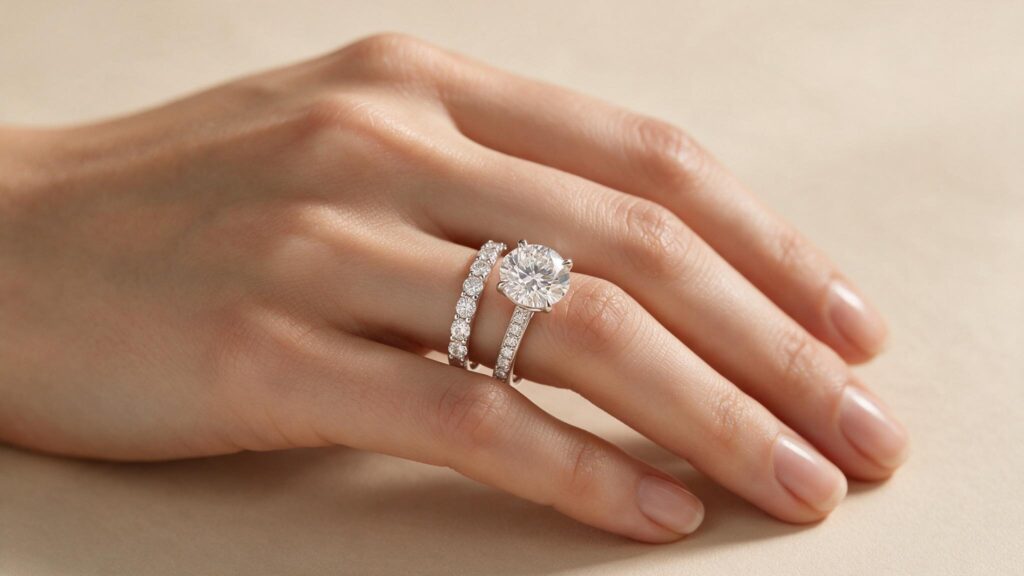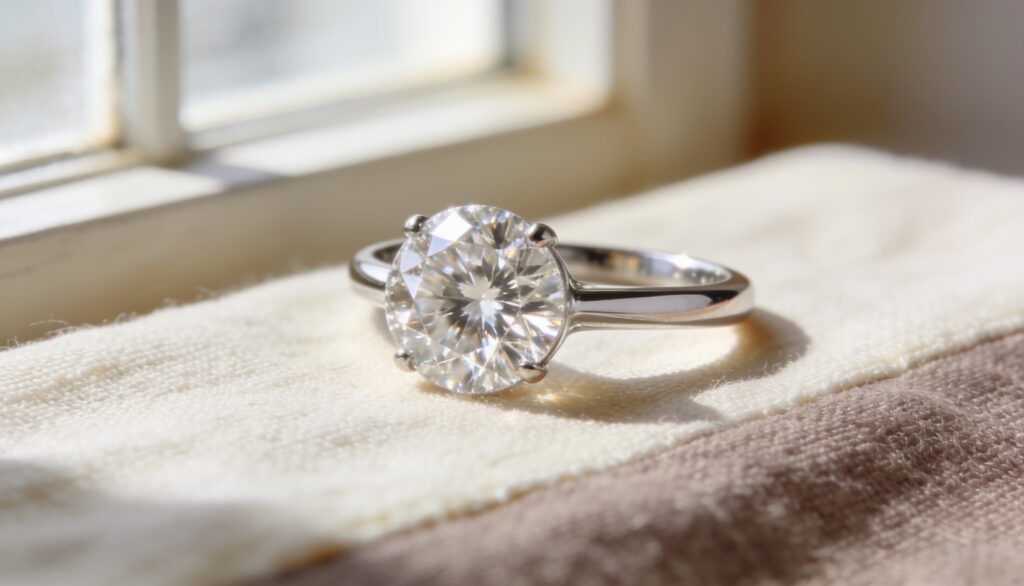
I’m Suman Smith, founder of Lux Jewels. In 2015 I became the first jeweler in Canada to offer lab grown diamond engagement rings. At that point most people hadn’t heard of them. Most jewelers refused to carry them. I spent three years vetting the science and the supply chains before I said yes. Now, eleven years later, lab grown diamond engagement rings (also called lab created diamond engagement rings) account for 48 percent of US engagement ring sales according to BriteCo’s 2025 industry data. That’s up from 8 percent in 2020.
Here’s the honest version of what changed: a 2-carat lab grown diamond with excellent cut and VS1 clarity now runs $2,400 to $6,000 CAD. The same stone mined from the ground costs $20,000 to $33,000 CAD. Same carbon structure. Same hardness. Same brilliance. The only difference is where it was born, and a supply chain that adds middlemen instead of quality.
But here’s what most guides won’t tell you, and this is the part that matters: not all lab grown diamonds are equal. A lot of the stones flooding the market right now have visible yellow tints, cloudy inclusions, and certificates that paint a prettier picture than the stone deserves. In the trade, we call these “bluff diamonds.” They exist because lab grown production exploded faster than quality standards could keep up, and because some retailers care more about margin than about what ends up on your fiancee’s finger. I’m going to show you how to spot them, what to ask for, and why pioneering this category in 2015 taught me which quality filters actually work.
Quick Answer
Lab Grown Diamond Engagement Rings
Want expert eyes on a specific stone or quote?
$199 | 30 minutes | Video call
The first and only service of its kind in the world. Pricing subject to change. Confirm current rate at stan.store/luxjewels before booking.
Are Lab Grown Diamonds Real Diamonds?
Yes. Not “almost real.” Not “basically real.” Real. Lab grown diamonds are 100 percent carbon arranged in the exact same crystal structure as mined diamonds (face-centered cubic lattice). Every physical property is identical: 10 on the Mohs hardness scale, refractive index of 2.417, dispersion of 0.044, density of 3.52 grams per cubic centimeter. Standard diamond testers read them as diamond because their thermal conductivity matches mined diamonds perfectly. The only way to identify a stone as lab grown specifically is specialized gem lab equipment like DiamondView that examines growth patterns at the molecular level.
The FTC Settled This in 2018
In July 2018 the US Federal Trade Commission revised its Jewelry Guides. Before 2018, the legal definition of a diamond included the word “natural,” which retailers used to argue lab grown stones weren’t technically diamonds. After 2018, the word “natural” was removed. The current legal definition reads: “A diamond is a mineral made almost entirely of pure carbon crystallized in the isometric system.” Lab grown diamonds meet that definition. So do mined diamonds. Both are diamonds. Any jeweler still saying otherwise is either misinformed or hoping you are.
For the full FTC ruling breakdown and the real vs fake framing, see the comparison pillar page:
How Are Lab Grown Diamonds Made?
Two methods dominate the market: CVD and HPHT. They produce different outcomes, and the method a retailer uses affects stone quality more than they usually disclose.
CVD (Chemical Vapor Deposition)
CVD is the method used for almost all engagement ring quality lab grown diamonds today. A small diamond seed plate goes into a vacuum chamber. Methane gas is pumped in. The chamber is heated to around 800 degrees Celsius. Plasma breaks the methane into carbon atoms, which settle layer by layer onto the seed, growing a new diamond crystal. The whole process takes 2 to 4 weeks per stone. Finished rough is cut and polished using the exact same equipment and grading standards as mined rough.
CVD stones are what you want for an engagement ring because they grow in controlled, uniform conditions that produce Type IIa quality much more reliably than HPHT. Most Type IIa lab grown stones on the market are CVD.
HPHT (High Pressure High Temperature)
HPHT simulates the geological conditions that make mined diamonds. A metal press creates extreme pressure (around 5 GPa) and temperature (around 1,400 degrees Celsius) around a carbon source and seed. Process time is shorter than CVD (days vs weeks), but HPHT commonly leaves metallic inclusions from the growth process that degrade optical clarity. HPHT is used more for industrial diamonds and for color enhancement of existing stones. Less common for engagement ring quality.
Why This Matters for Buyers
If a seller won’t tell you whether your stone is CVD or HPHT, that’s a flag. It doesn’t mean they’re hiding bad quality automatically, but it means they don’t have the vendor relationships to know. Good retailers know the growing method for every stone they sell. Ask.
Type IIa: The Quality Filter Most Buyers Don't Know About
This is the single most important technical concept in this entire guide. If you take one thing from reading this, take this: ask if the lab grown diamond you’re considering is Type IIa. If it isn’t, walk.
What Type IIa Means
Diamonds are categorized by nitrogen content into four types: Type Ia, Type Ib, Type IIa, and Type IIb. The categories come from how nitrogen atoms distribute inside the crystal structure. Nitrogen is the impurity that causes yellow tint, cloudiness, and reduced brilliance.
Diamond Type | Carbon Purity | Market Share | Visual Impact |
Type Ia | 98-99% | ~95% of natural diamonds | Most common; nitrogen clusters create yellow tint |
Type Ib | 98-99% | ~0.1% of natural diamonds | Isolated nitrogen creates strong yellow color |
Type IIa | 99.95%+ | <2% of all diamonds | Colorless, exceptional clarity, maximum brilliance |
Type IIb | 99.95%+ | <0.5% | Contains boron; natural blue diamonds |
Why Type IIa Is the Right Standard for Engagement Rings
Type IIa diamonds are over 99.95 percent pure carbon, which means they have virtually no nitrogen impurities. This translates to colorless appearance (no yellow undertone), exceptional clarity (no nitrogen-related clouding), and maximum brilliance (light passes through cleanly without being absorbed by impurity atoms).
Historically, Type IIa diamonds made up less than 2 percent of mined diamonds. The Cullinan Diamond, the Koh-i-Noor, the Hope Diamond, most famous stones in crown jewels collections, all Type IIa. This is the quality level that museums display.
At Lux Jewels, every lab grown diamond engagement ring we source is Type IIa. Not because it sounds impressive on marketing copy, but because the alternative is selling clients stones that will develop visible yellowing or cloudiness over years of wear. Type IIa is the only type I trust for a ring someone will wear every day for 50 years.
How to Verify Type IIa Status
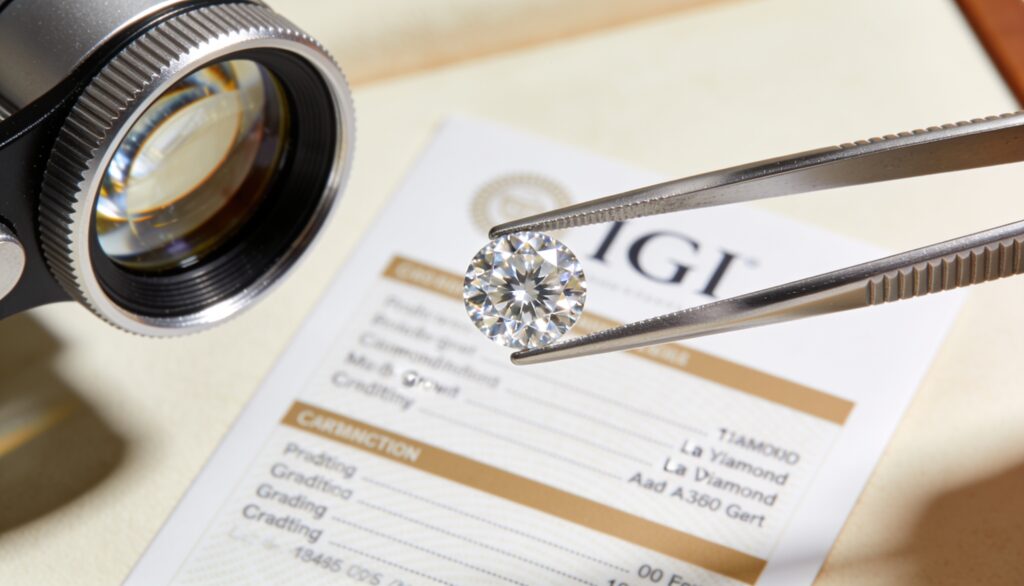
Both GIA and IGI grade diamond type on their certificates. Look for the line that reads “Type IIa” on the grading report. If the certificate doesn’t specify type, that’s almost always because it isn’t Type IIa. Sellers who have Type IIa stones advertise Type IIa. Sellers who don’t, don’t mention type at all.
Also: Type IIa alone isn’t enough. You still want Excellent cut, VS1 clarity or better, and D-F color grade. Type IIa is the quality floor, not the whole standard.
Bluff Diamonds: Why Most Lab Grown Rings Look Cloudy or Yellow
This is the section nobody else writes. Bluff diamonds are the quiet scandal of the lab grown industry in 2026. I’m going to explain exactly what they are, why they exist, and how to spot them before you buy.
What Makes a Bluff Diamond
A bluff diamond is a mined (and sometimes lab grown) stone whose certificate grades it better than its actual visual appearance warrants. The certificate reads F color, VS2 clarity, Excellent cut. Looks great on paper. But in person the stone has a grey undertone in daylight, visible inclusions near the table, noticeable asymmetry, or brown tints under certain lighting. The paper says one thing. Your eyes say another.
Bluff diamonds exist because the diamond market has always had certification inconsistencies. Some labs grade more generously than others to win business, offering more affordable, faster grading than GIA or IGI. Some of those labs grade more generously to win business. A stone that GIA would call H/SI1 gets called F/VS2 by a weaker lab. You pay F/VS2 money for H/SI1 quality. That’s the bluff.
The Four Tells
- Non-GIA, non-IGI certification: Every legitimate diamond should be graded by GIA (Gemological Institute of America) or IGI (International Gemological Institute). If the certificate is from EGL, GSI, WGI, HRD, or any lab you haven't heard of before, treat it as suspicious. Not automatically fraud, but grade it against GIA standards yourself and assume everything is one to two grades lower than stated.
- Price that's too low for the stated specs: If a "D color, VS1 clarity, Excellent cut, Type IIa" 2-carat lab grown stone is listed at $1,800 CAD when GIA-certified equivalents are $4,000 CAD, that price gap isn't a discount. It's a quality gap.
- No video or limited photography: Legitimate sellers provide 360-degree video of every stone over 0.5 carats. If video is missing or the angle is restricted to flatter the stone, there's something the seller doesn't want you to see.
- "Nitrogen content not specified" on certificate: If the report doesn't list Type IIa, the stone isn't Type IIa. See the Type IIa section above for why that matters.
A Real Example
A client brought me a quote last year for a 1.8-carat lab grown stone graded F/VS1 by a lab I’d never heard of. Price: $2,200 CAD. He thought he’d found the deal of the century. I asked him to get a GIA re-certification before finalizing. The re-grade came back H/SI1, not Type IIa. At GIA standards that stone was worth maybe $1,400 CAD. He’d been quoted $2,200 CAD for a stone that was worth $1,400 CAD. The “discount” off some fictional retail price was the whole scam. He walked away. Bought a GIA-certified F/VS1 Type IIa equivalent from a different retailer for $2,800 CAD (real market price) and ended up with an actual F/VS1 Type IIa stone.
Reviewing a specific stone or quote?
$199 | 30 minutes | Video call
The first and only service of its kind in the world. Pricing subject to change. Confirm current rate at stan.store/luxjewels before booking.
Lab Grown Diamond Engagement Ring Prices in 2026
Real CAD prices for lab grown diamond engagement rings at Type IIa quality, D-F color, VS1 clarity or better, Excellent cut, set in 14k white or yellow gold with a standard solitaire or hidden halo setting:
Carat Size | Lab Grown (Type IIa, D-F, VS1+) | Mined Equivalent | You Save |
0.5 ct | $800 - $1,400 CAD | $3,500 - $6,500 CAD | ~77% |
1.0 ct | $1,500 - $3,500 CAD | $8,500 - $15,000 CAD | ~79% |
1.5 ct | $2,200 - $4,800 CAD | $14,000 - $24,000 CAD | ~81% |
2.0 ct | $2,400 - $6,000 CAD | $20,000 - $33,000 CAD | ~82% |
3.0 ct | $5,500 - $11,000 CAD | $40,000 - $65,000 CAD | ~83% |
These ranges include the setting (14k gold, standard designs). Custom settings with intricate metalwork or rare design features add $1,500 to $4,000 CAD. Fancy shapes like oval, emerald, or pear run about 10 to 15 percent more affordable per carat than round brilliant at the same quality grade, because round brilliant costs more to cut from rough.
Why Lab Grown Costs Less: The 4-5 Layer Supply Chain
Natural diamonds pass through 4 to 5 layers of middlemen between the mine and the retail showroom. Each layer adds markup. Here’s the real structure:
- Layer 1: Mining operation (De Beers, Alrosa, or smaller operators) extracts rough. Markup: base cost.
- Layer 2: Rough trader buys from mining companies and sells to cutters. Markup adds 20 to 30 percent.
- Layer 3: Cutting and polishing facility (mostly in India) turns rough into cut stones. Adds 15 to 25 percent.
- Layer 4: Wholesaler (sometimes 2 or 3 wholesale layers) buys cut stones and sells to retailers. Each wholesale layer adds 20 to 30 percent.
- Layer 5: Retailer sells to you. Adds 100 to 250 percent (retail showroom markup).
Lab grown compresses this into 1 to 2 layers: grower cuts and polishes in-house, then sells to retailers direct, or grower to cutter to retailer. No rough trader. No wholesale layers. That’s the entire reason lab grown costs 70 to 80 percent less for identical specs. Not lower quality. Compressed supply chain.
For a deeper comparison of how lab grown and mined diamonds differ across all buying factors, see:
The 4Cs for Lab Grown Diamond Engagement Rings
The 4Cs (Cut, Color, Clarity, Carat) work the same way for lab grown as they do for mined diamonds. But priorities shift a little because lab grown pricing lets you buy higher grades without blowing your budget.
Cut (Most Important, Always)
Cut determines how light moves through the stone and returns as brilliance and fire. A poorly cut D color stone looks worse than a well-cut H color stone. Never compromise on cut. Always buy Excellent or Ideal cut. With lab grown pricing advantages, Excellent cut is achievable at any budget, so there’s no reason to settle.
Color
GIA grades color D (colorless) through Z (light yellow). For engagement rings, stay D-F (colorless) if you want maximum whiteness or G-H (near colorless) if you want bigger size at the same budget. I-J grades show noticeable warmth. Most eyes can’t tell the difference between D and G at normal distance.
Clarity
Clarity grades run from Flawless (FL) down to Included (I3). For engagement rings, VS1 is the sweet spot: inclusions exist but are invisible to the naked eye. VS2 is usually fine too if you verify the inclusion isn’t near the table. Skip SI and I grades for lab grown because the cost savings don’t justify visible imperfections when VS1 is already affordable.
Carat
Carat is where lab grown pricing rewrites the rules. A mined 1-carat ring for $8,500 CAD becomes a 2-carat lab grown ring at the same price point. Buyers who wanted bigger stones but couldn’t afford mined can now access sizes that used to require $20,000+ budgets. But bigger isn’t always better. Make sure the stone fits her hand proportions, her lifestyle (active hands need low-profile settings), and her aesthetic preference.
Popular Shapes and Settings for Lab Grown Diamond Engagement Rings
Shape Popularity (2026 Data)
- Round Brilliant: Still the most popular (around 40 percent of engagement rings). Maximum brilliance, classic look. Most expensive per carat.
- Oval: Second most popular and the fastest-growing shape since 2022. Elongates the finger, looks bigger per carat than round, 10 to 15 percent more affordable per carat.
- Emerald Cut: Vintage-elegant, step-cut reveals clarity (so needs VS1+). Around 8 percent market share.
- Princess Cut: Modern geometric, better price per carat than round. Around 7 percent market share.
- Cushion: Romantic soft square, good brilliance, 5 to 10 percent more affordable per carat than round.
- Pear: Distinctive teardrop shape, good for buyers wanting something less traditional.
- Radiant and Asscher: Less common, specific style preferences.
Setting Options
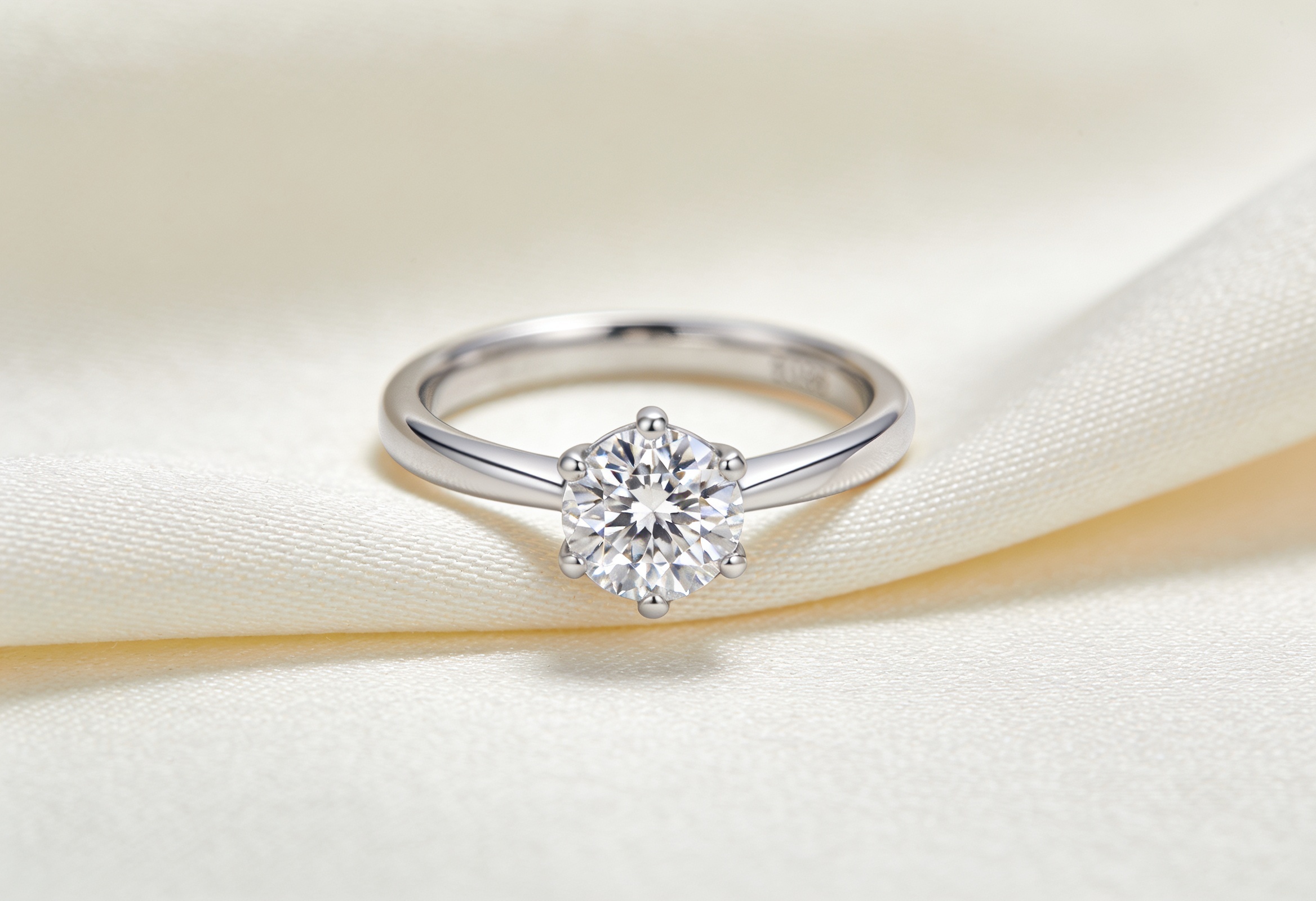
- Solitaire: Single stone on a plain band. Cleanest, most affordable, lets the stone speak for itself.
- Halo: Small stones surround the center stone, making it look 15 to 20 percent larger. Great for maximizing visual size on a smaller center stone.
- Hidden Halo: Halo sits under the center stone visible only from the side. Gives sparkle without changing the top-down silhouette.
- Three Stone: Past, present, future meaning. Adds visual weight. Works well with narrow hands.
- Vintage / Art Deco: Milgrain edges, filigree detail, heirloom aesthetic.
Where to Buy Lab Grown Diamond Engagement Rings
This is the section most jewelers won’t write because we’re supposed to tell you to buy from us. I’m going to tell you the truth instead: where you should buy depends on what you value.
Chain Retail Stores
The highest-markup option. 200 to 300 percent markup over wholesale. You’re paying for showroom rent, commissioned sales staff, display inventory, and advertising. Quality varies widely. Certification often comes from mid-tier labs rather than GIA/IGI. Upside: you can see stones in person and walk out the same day. Downside: you’re paying 40 to 60 percent more than the same stone costs elsewhere.
Online Retailers
Companies like Brilliant Earth, James Allen, Clean Origin, and Blue Nile. Markup of 30 to 75 percent over wholesale. Video review of every stone. GIA/IGI certification standard. Good inventory depth. Upside: best pricing for standard designs, clear policies, no sales pressure. Downside: no hands-on, limited custom design capability, customer service is transactional.
Independent Custom Jewelers
Jewelers like Lux Jewels who don’t carry inventory and source to your specifications. We work at 30 to 40 percent total markup including design labor, because we don’t carry showroom inventory and aren’t paying commissions. Upside: custom design, expert filtering (we refuse stones that don’t meet our Type IIa quality standard), personalized consultation. Downside: longer timeline (4 to 8 weeks typical), requires trust in the jeweler, less practical if you want to walk out the same day with a ring.
What I Tell Clients
If your budget is under $2,500 CAD and you want standard specs, online retailers probably beat what I can offer on pure price. Buy online. If your budget is $3,000 CAD or above, or if you want something that fits your partner specifically instead of a catalog ring, custom jewelers can usually beat online retailers on total value. If you want to walk into a showroom and leave with a ring today, chain retail is your only option, but budget 40 to 60 percent more than equivalent specs would cost elsewhere.
For Vancouver and Canadian buyers specifically, we offer custom lab grown diamond engagement rings with virtual consultations and shipping to your location. See:
What to Ask a Jeweler Before Buying a Lab Grown Diamond Engagement Ring
Copy this list. Send it to any jeweler you’re considering. Their answers (or the answers they avoid) will tell you everything you need to know.
- Is this stone Type IIa? (Answer should be "yes, and it's listed on the certificate.")
- Is the certification from GIA or IGI? (Any other lab answer is a flag.)
- Was the stone grown using CVD or HPHT? (They should know this without hesitation.)
- Can I see 360-degree video of this specific stone? (Every legitimate seller has this.)
- What is the exact cut grade, and is it Excellent or Ideal? (Not "very good," not "great," Excellent or Ideal.)
- What is the return policy if I don't love it in person? (30 days minimum, full refund.)
- Who grew this stone, and where? (Good sellers know their grower supply chain.)
- Is the setting price separate from the stone price? (It should be, for transparency.)
- What's the upgrade policy if we want to move up in size later? (Most custom jewelers offer lifetime upgrades.)
- Is there a warranty on the setting and stone mounting? (Lifetime warranty is standard for quality jewelers.)
Frequently Asked Questions
Are lab grown diamond engagement rings real?
Yes. Lab grown diamonds are real diamonds. They share identical chemistry (pure carbon), optical properties, and physical properties with mined diamonds. The FTC confirmed this in 2018 by removing the word “natural” from the legal definition of a diamond. Standard diamond testers read them as diamond.
Are lab grown diamonds more affordable?
Yes, 70 to 80 percent more affordable for identical specs. A 1-carat lab grown with excellent cut and VS1 clarity runs $1,500 to $3,500 CAD vs $8,500 to $15,000 CAD mined. The savings come from a compressed supply chain (1-2 layers vs 4-5 for mined) and lower production cost per carat.
How much is a 1-carat lab grown diamond ring?
A 1-carat lab grown diamond engagement ring at Type IIa quality, D-F color, VS1 clarity or better, Excellent cut, in a 14k gold setting, runs $1,500 to $3,500 CAD in 2026. Premium custom settings add $1,500 to $4,000 CAD. Chain retail stores often charge $3,500 to $6,000 CAD for the same specs due to higher markup.
What's the best lab grown diamond engagement ring shape?
Round brilliant offers maximum brilliance but costs 10 to 15 percent more per carat. Oval is the fastest-growing shape (elongates the finger, looks bigger per carat, more affordable than round). Emerald cut needs VS1+ clarity because step-cut reveals inclusions. The right shape matches her existing style, not what’s trending.
Are lab grown diamonds good quality?
Quality varies dramatically. Type IIa stones (over 99.95 percent pure carbon) with Excellent cut and GIA or IGI certification are the highest quality and what you want. Non-Type IIa stones with mid-tier lab certification can have yellow tints, cloudy inclusions, or overstated grades (bluff diamonds). Ask specifically for Type IIa and GIA or IGI grading.
How can I tell if a lab grown diamond is good quality?
Check four things. First, Type IIa status listed on the certificate. Second, GIA or IGI grading (not EGL, GSI, or unknown labs). Third, Excellent or Ideal cut grade. Fourth, D-F color and VS1 clarity minimum. If the certificate doesn’t specify Type IIa, the stone isn’t Type IIa. If the certificate is from a lab you haven’t heard of, grade the stone one to two levels lower than stated and adjust price accordingly.
Can you tell a lab grown diamond from a mined one?
Not with standard jewelry store equipment. Diamond testers read both as diamond because thermal conductivity is identical. Loupe examination doesn’t distinguish them reliably. Only specialized gem lab equipment (DiamondView, Raman spectroscopy) can identify lab grown stones. The certificate itself (laser-engraved on the girdle) is the practical proof of origin.
Do lab grown diamonds hold their value?
Not as well as mined diamonds. Lab grown retains 5 to 20 percent of retail on resale. Mined retains 25 to 50 percent. Neither is a good investment; both lose most retail markup immediately. If you plan to keep the ring forever, resale value is irrelevant. If you care about resale percentage, mined holds more.
Are lab grown diamond engagement rings available in Canada?
Yes. Lux Jewels has been offering lab grown diamond engagement rings in Canada since 2015 and was the first Canadian jeweler to do so. Online retailers ship to Canada. Most major Canadian retailers now carry lab grown inventory. Pricing is typically 70 to 80 percent below mined equivalents across Canadian retailers, same as the US market.
About Suman Smith
I started Lux Jewels in 2007 after years in the traditional diamond industry. What pushed me to start my own business was watching couples get talked into the wrong rings by salespeople on commission. Wrong for their budgets. Wrong for their partners’ styles. Wrong for the lives they were actually building. I wanted a different kind of jewelry business.
In 2015 I made the call that redefined Lux Jewels: I became the first jeweler in Canada to offer lab grown diamond engagement rings. This was before the category was mainstream. Before Brilliant Earth and Clean Origin and the online retailers that now dominate. I’d spent three years researching CVD production, vetting grower supply chains, and testing stone quality in my workshop. When I was satisfied the science was solid and the quality was real, I offered them to clients. The first year, almost nobody wanted them. By 2020, about half of my engagement ring clients were asking. Today, most are.
My No-BS Diamond Buying Call exists because I kept seeing the same patterns: people overpaying, people getting sold bluff diamonds, people buying rings that didn’t fit their partners at all. For $199 you get 30 minutes of my expertise. I’ll review any stones, any quotes, any rings you’re considering from any seller. If you don’t buy from Lux Jewels, that’s fine. Business of people first, jewelry second. That’s how Lux Jewels has run for over 20 years, and it’s how we’ll keep running.
Since 2015, we have been making people smile, hug, kiss, laugh, and cry, in a good way.
Ready to find the right lab grown diamond engagement ring?
$199 | 30 minutes | Video call
The first and only service of its kind in the world. Pricing subject to change. Confirm current rate at stan.store/luxjewels before booking.